Rally organizers don’t get to create one set of driving rules that applies everywhere. When an organized car rally crosses national borders, the route has to account for the laws of every country the drivers enter. That can include speed limits, vehicle requirements, insurance, driver’s licenses, border documentation, and local road rules. The organizer’s job is to build the event around those requirements, while each driver remains responsible for following the laws where they are driving.
For an international exotic car rally, that preparation happens long before the first car leaves the starting line.
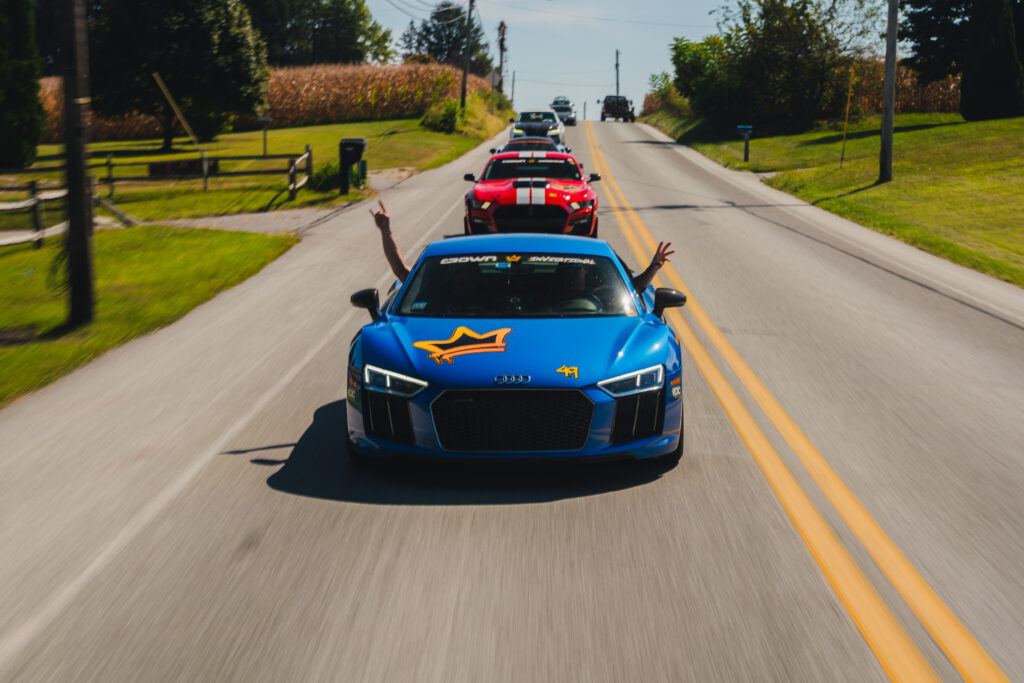
A road that crosses a border doesn’t suddenly become a different kind of road.
But the laws governing it can change.
Speed limits may be different. Vehicle equipment requirements may change. A driver’s license that is accepted in one country may require additional documentation in another. Insurance requirements can also vary.
For someone taking a normal vacation, these details can be easy to overlook.
For a rally organizer moving a group of high-performance cars across borders, they have to be considered when the route is being planned.
That’s why a good international rally isn’t simply a route drawn on a map.
The legal requirements are part of the route planning.
Government travel guidance makes the same point for international drivers: travelers need to check the driving rules, insurance requirements, documents, and vehicle requirements for the countries they plan to visit.
The first step is understanding where the rally is actually going.
An organizer needs to know which countries, states, provinces, cities, and roads the participants will travel through.
From there, the route can be reviewed for things such as:
For an exotic car rally, route selection has another consideration that a normal tour might not.
The cars themselves.
A route that looks perfect on a map may not be suitable for a group of low-clearance supercars.
Crown Rally describes its organized rallies around carefully planned routes, destinations, checkpoints, and experiences rather than simply sending drivers from one city to another.
Sometimes, depending on the route and the event.
There isn’t one universal “international rally permit.”
The requirements depend on the country, the roads being used, the size and nature of the event, and what the organizer is actually doing.
A group of privately owned vehicles traveling together isn’t necessarily treated the same way as an event that closes roads, controls traffic, uses public facilities, or organizes a formal competitive activity.
Some locations may require organizers to coordinate with local authorities.
Others may simply require the participants to follow normal traffic laws.
This is why experienced rally organizers don’t assume that the same process works in every country.
They check the requirements for the actual route.
This is one area where there is no room for interpretation.
A rally doesn’t override the speed limit.
If the posted speed limit changes when the group crosses a border, drivers are expected to follow the new limit.
The same applies to traffic signals, lane rules, passing restrictions, road signs, and other local regulations.
Crown Rally’s own published etiquette guidance makes the point clearly: rallies take place on public roads, and participants are expected to follow posted speed limits and traffic laws.
Its participation terms go further, requiring participants to comply with the laws and regulations of the city, county, state, and country where they are present.
That’s important for the organizer as much as it is for the driver.
One person’s bad decision can create problems for an entire event.
This can become important when participants come from different countries.
A driver may have a license issued by their home country, while the rally is traveling through several others.
Whether that license is recognized—and whether an International Driving Permit or other documentation is needed—depends on the countries involved.
That’s why organizers should communicate documentation requirements before participants arrive.
Drivers shouldn’t discover at the border that they were supposed to bring another document.
For example, Crown Rally’s participation terms specify the driver’s license requirements for its events and state that participants may also use an International Driving Permit.
For a truly international event, organizers need to go further and make sure participants understand the requirements applicable to their specific nationality and route.
This is where an international rally becomes very different from a domestic one.
At a border, there can be questions about both the driver and the vehicle.
Organizers may need to prepare participants for requirements involving:
The exact requirements depend entirely on the countries involved.
Crown Rally’s published material discussing cross-border rallies specifically notes that participants traveling between the United States and Canada need to comply with customs and border regulations for both drivers and vehicles.
That’s why border crossings shouldn’t be treated as an afterthought.
They’re part of the event logistics.
For larger or more complicated events, local coordination can be an important part of the planning process.
That might involve understanding road restrictions, parking arrangements, event locations, local traffic conditions, or other requirements.
The amount of coordination depends on the event.
A group simply traveling along public highways is different from an event that needs exclusive access to a location or special traffic arrangements.
Crown Rally’s own content describes professional organizers as handling route planning and logistics while emphasizing that participants remain responsible for legal compliance.
That distinction is important.
Organizers manage the event. Drivers operate the vehicles.
A good rally organizer does more than find beautiful roads.
They think about what happens after the route is published.
They ask:
That work isn’t necessarily visible to participants.
And that’s usually a good thing.
When everything has been planned properly, the driver gets to focus on the experience instead of the logistics behind it.
Request Invitation